
Most small businesses do not think about their technology when everything appears to be working. The concern begins when a server fails, the network slows down, employees lose access to core business applications, or customers cannot reach the services they need. Without proactive monitoring, a small issue inside your IT infrastructure can develop quietly until …

Most small businesses do not think about their technology when everything appears to be working. The concern begins when a server fails, the network slows down, employees lose access to core business applications, or customers cannot reach the services they need. Without proactive monitoring, a small issue inside your IT infrastructure can develop quietly until it interrupts business operations, creates unexpected costs, or exposes sensitive data.
At Third-Eye Tech, we believe you should not have to wonder who is watching your IT systems. Our small business managed IT services give your business continuous monitoring, responsive help desk support, and practical IT infrastructure management services built around your business needs. We look after your technology, strengthen network security, and address security vulnerabilities before they have the chance to affect productivity, customer trust, or future growth.
Key Takeaways
- Small business managed IT services replace reactive repairs with proactive monitoring, preventive maintenance, and structured risk management.
- IT infrastructure management covers your network infrastructure, servers, operating systems, cloud computing platforms, endpoints, software components, user accounts, and data storage.
- Continuous monitoring, patch management, endpoint security, and tested disaster recovery help reduce downtime and protect business continuity.
- Managed IT services give small businesses access to technical expertise, predictable costs, stronger data security, and compliance management without the expense of a full internal IT department.
- At Third-Eye Tech, we align your IT with your business goals so your technology supports smooth operations and sustainable growth.
When IT Breaks, and No One Is Watching
Most technology failures do not begin as major emergencies. They often start with a missed update, a failing hard drive, an overlooked alert, a misconfigured firewall, or an application that is consuming more resources than it should. When no one is monitoring the existing infrastructure, these warning signs can remain hidden until employees cannot work and customers begin to feel the impact.
For a small business owner, that disruption is personal. You may be dealing with missed appointments, delayed invoices, lost sales, frustrated employees, and customers who expect an immediate explanation. Your attention is pulled away from running the company while you try to find someone who can identify the problem, restore the affected IT systems, and prevent the same issue from happening again.
This is the risk created by unmanaged IT infrastructure. Without structured infrastructure management, patch management, software management, and clear security protocols, small problems can grow into costly outages or a data breach.
At Third-Eye Tech, our infrastructure management services replace that uncertainty with continuous oversight, helping your business identify emerging threats, maintain system reliability, and keep technology working at optimal performance.
What IT Infrastructure Management Actually Covers
IT infrastructure management is the ongoing process of monitoring, maintaining, supporting, and securing the technology your business relies on every day. Effective IT infrastructure management services do not focus on one device or application. They consider the full IT environment and the way each critical component affects your employees, customers, and business operations.
At Third-Eye Tech, our services include:
Network infrastructure
We monitor routers, switches, firewalls, wireless access points, and network protocols that keep your employees connected. Strong network security and robust security measures help prevent unauthorized access while supporting stable connectivity throughout your business.
Servers and information systems
We monitor physical and virtual servers that host files, databases, line-of-business platforms, and other information systems. This allows us to track system performance, identify capacity concerns, and respond before a server issue affects your core business applications.
Operating systems
We keep operating systems updated, supported, and configured according to appropriate security requirements. Consistent patch management reduces known security vulnerabilities and helps your devices remain compatible with the software components your employees use.
Cloud computing
We manage cloud computing environments, Microsoft 365 services, cloud applications, permissions, and configuration settings. Proper cloud oversight supports data security, cost efficiency, and access to important resources without leaving avoidable security risks in place.
Endpoints
Endpoint security protects laptops, desktops, mobile devices, and other connected equipment. We apply cybersecurity measures, monitor device health, and help prevent one compromised endpoint from spreading a threat across your computer network.
Software management
Software management includes updates, licensing, compatibility checks, and the removal of unsupported applications. We also use a configuration management tool to document settings, identify configuration drift, and keep software components aligned with established best practices.
Data storage and backups
We help protect data storage systems, preserve data integrity, and maintain secure backup processes. Reliable backups and disaster recovery planning are essential for ensuring business continuity after ransomware, hardware failure, accidental deletion, or another disruption.
User accounts and access
We manage user accounts, permissions, authentication, and access levels so employees can reach the resources they need without receiving unnecessary direct access to sensitive systems. These security controls help protect sensitive data and reduce cyber risk from compromised credentials or insider misuse.
Vendor management
We coordinate with internet service providers, software vendors, cloud providers, and other technology partners on your behalf. Effective vendor management reduces delays, prevents finger-pointing, and gives your business one team that takes responsibility for resolving the issue.
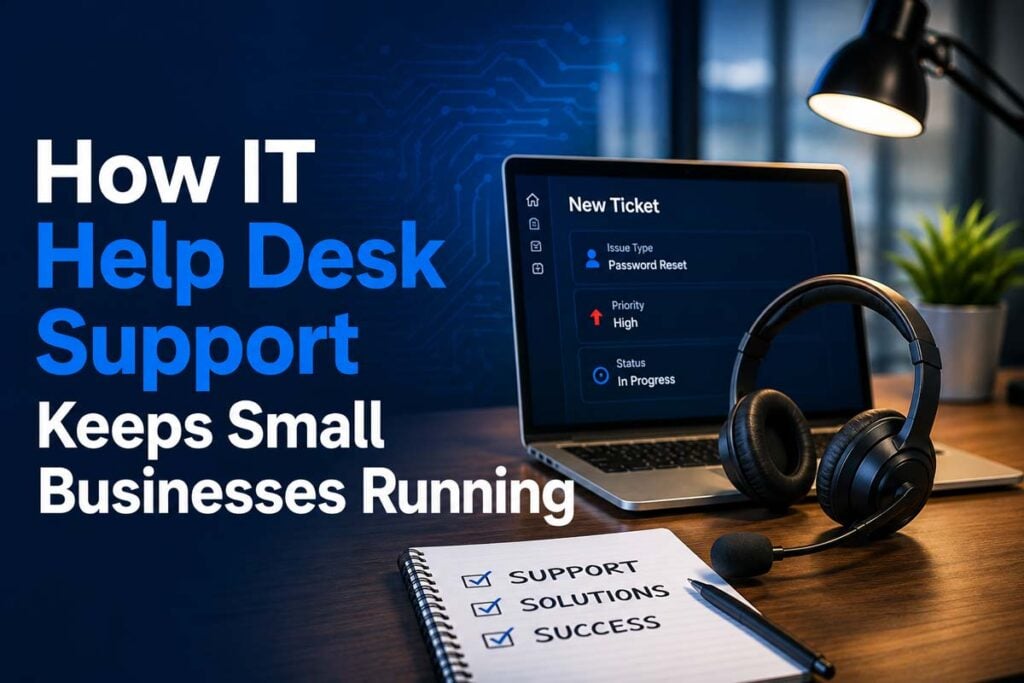
Help desk and desk support
Our help desk gives employees a clear place to turn when they experience login problems, software errors, connectivity issues, or device concerns. Responsive desk support keeps minor problems from becoming larger disruptions and helps your team return to productive work sooner.
Together, these services create a structured approach to IT service management. Rather than treating every issue as an isolated ticket, our service management process connects day-to-day support with long-term infrastructure management, risk management, security considerations, and your wider business objectives.
The Risks of Unmanaged IT Infrastructure
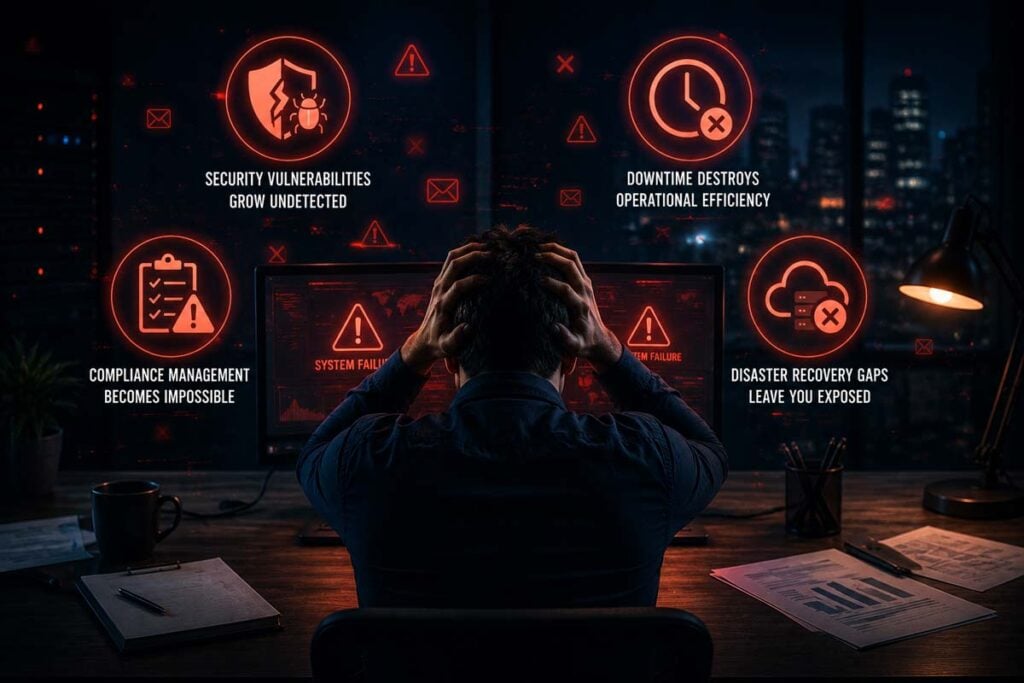
Small businesses often rely on a combination of older devices, cloud platforms, third-party software, and informal processes that developed as the company grew. That existing infrastructure may still function, but without consistent IT management, it can become difficult to see which systems are outdated, where security gaps exist, or how one failure could affect the rest of the business.
Security Vulnerabilities Can Grow Undetected
- Unpatched operating systems, outdated applications, weak passwords, and default settings create security vulnerabilities that malicious actors can exploit.
- Cyber threats are constantly changing, and emerging technologies allow attackers to automate scans, test credentials, and identify weaknesses faster than many small businesses can respond.
- At Third-Eye Tech, we use proactive monitoring, patch management, endpoint security, and threat detection to strengthen your security posture.
- We monitor security metrics, review alerts, and analyze data from across the IT environment so we can identify emerging threats earlier and apply the right security measures before an incident escalates.
Downtime Can Disrupt Your Entire Business
- When a critical component of your IT infrastructure fails, employees may lose access to email, files, customer records, payment systems, or core business applications.
- Even a short outage can reduce operational efficiency, delay service, and damage the customer experience.
- Our continuous monitoring helps us track system performance, capacity, and unusual activity around the clock.
- By identifying warning signs early, we can often address the cause before it interrupts business operations, helping your company maintain smooth operations and optimal performance.
Compliance Becomes Harder to Manage
- Regulatory compliance is not limited to large corporations.
- Depending on your industry and the type of sensitive data you hold, your business may need to meet HIPAA, PCI DSS, GLBA, FTC Safeguards Rule, CMMC, FINRA, or contractual security requirements.
- Informal IT management rarely provides the documentation, security controls, risk assessment, and repeatable processes needed for effective compliance management.
- At Third-Eye Tech, we help your business establish cybersecurity measures, maintain evidence, and align its information systems with relevant regulatory compliance obligations.
Disaster Recovery Gaps Leave Your Business Exposed
- Backups are only useful when they are complete, protected, and ready to restore.
- Without a documented disaster recovery plan, a ransomware attack, hardware failure, or data breach can leave your team unsure of what to recover first, who should act, or how long restoration may take.
- Our disaster recovery planning focuses on your business needs, recovery priorities, data storage, and critical systems.
- We test the process, document core responsibilities, and build a practical path to regain access while ensuring business continuity during an unexpected event.
Poor Visibility Makes Risk Management Reactive
- You cannot manage a risk you cannot see.
- Without accurate inventory, monitoring, and security metrics, business owners may not know which devices are unsupported, which user accounts have excessive access, or whether backups are completing successfully.
We conduct a risk assessment of your existing infrastructure, identify security risks, and prioritize improvements based on business impact. This effective risk management approach helps your company make informed decisions instead of spending money only after something has already failed.
What Small Businesses Gain From Our Managed IT Services
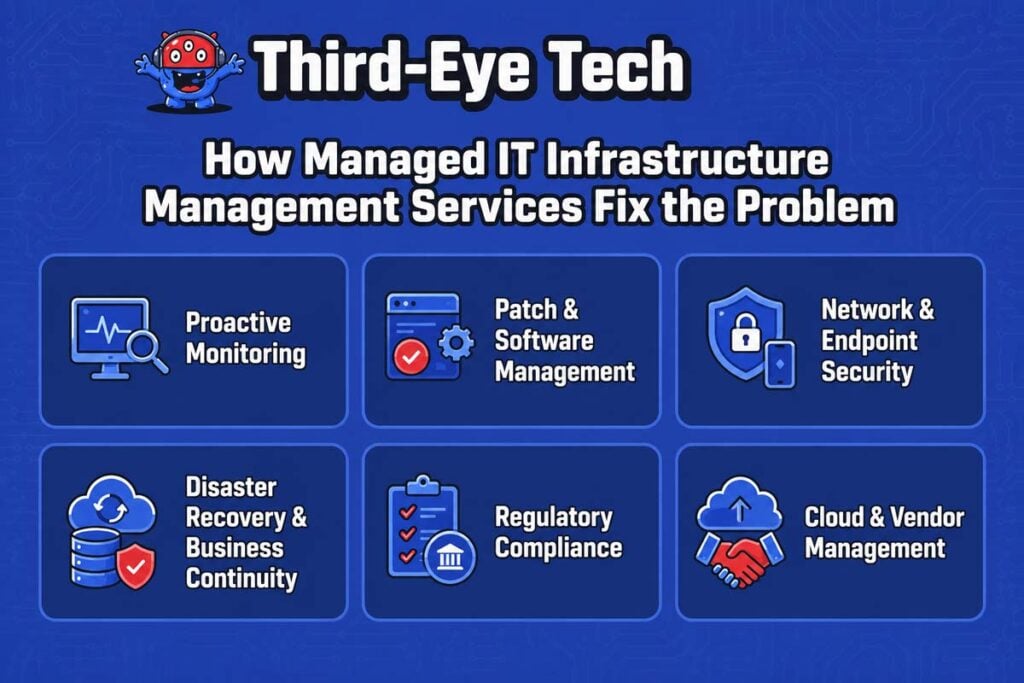
For many small businesses, building an internal IT department is not financially practical. You may need broad technical expertise across security, cloud computing, backups, compliance, networks, and support, but hiring a specialist for each area would be expensive. Our small business managed IT services give you access to a dedicated team for a predictable monthly cost. Our IT services provide ongoing IT management, help desk support, infrastructure management services, and planning without the overhead of recruiting, training, and retaining a full internal department.
More Predictable Costs
- Reactive repairs can create unpredictable bills, especially when a failure requires emergency support, replacement hardware, or extended downtime.
- A managed model improves cost efficiency by combining monitoring, maintenance, support, and planning into one consistent service.
- By preventing avoidable issues and standardizing your technology, we can also help reduce costs associated with downtime, duplicate software, unnecessary licenses, and poorly matched solutions. Cost efficiency does not mean choosing the cheapest option.
- It means making smarter technology decisions that support your business objectives.
Stronger Operational Efficiency
- Employees work more effectively when applications load correctly, devices are maintained, and support is easy to reach.
- Structured IT service management improves operational efficiency by reducing repeated problems and giving your team a clear path to help.
- Our help desk and desk support services resolve everyday issues while our infrastructure team looks for the underlying cause.
- This combination supports smooth operations, protects productivity, and helps your IT systems perform reliably.
Better Protection Against Cyber Risk
- Cyber risk affects every organization that uses email, stores customer data, accepts payments, or connects to the internet.
- Small businesses may be especially exposed because attackers know they often have fewer internal security resources.
- We combine security measures, threat detection, continuous monitoring, endpoint security, and employee-focused cybersecurity measures to create a layered defense.
- These robust security measures help reduce security risks, protect data integrity, and improve your ability to respond if a data breach occurs.
Technology That Can Support Future Growth
- Technology should not become a barrier every time you hire an employee, open a location, introduce a service, or adopt a new platform.
- Our tailored solutions consider your existing infrastructure, future growth, and the way your team actually works.
- We help you evaluate emerging technologies, plan upgrades, and choose IT services that can scale with your company.
- By aligning technology decisions with your business needs, we create an IT environment that supports sustainable growth instead of forcing you to rebuild systems every few years.
Final Thoughts
Technology problems rarely appear without warning. More often, they develop through missed patches, weak security protocols, failing hardware, configuration changes, or unusual activity that goes unnoticed inside your IT systems. Proactive monitoring and structured IT infrastructure management help identify these concerns early, reducing disruption and supporting optimal performance.
At Third-Eye Tech, we treat infrastructure management, data security, risk management, and business continuity as connected priorities. Our role is to monitor your IT environment, maintain the critical systems your employees depend on, and provide the technical expertise needed to make confident technology decisions.
In today’s competitive landscape, reliable technology is a critical component of customer service, productivity, and sustainable growth. With the right security controls, service management, and disaster recovery strategy in place, your business can strengthen its security posture, maintain data integrity, and keep moving forward even when unexpected problems occur.
Schedule a free IT Checkup with Caleb to find out what gaps exist in your IT infrastructure management system, and how we can help you manage them.
Frequently Asked Questions
What is IT infrastructure management?
IT infrastructure management is the ongoing process of monitoring, maintaining, and securing all the technology your business depends on, including network infrastructure, operating systems, data storage, cloud computing environments, and software components.
Why do small businesses need managed IT services?
Small businesses face the same cyber threats as larger organizations but with fewer internal IT resources. Managed IT services provide proactive monitoring, security controls, and disaster recovery planning, reducing risk and improving operational efficiency.
What is IT risk management for small businesses?
Effective IT risk management for small businesses involves identifying, assessing, and mitigating risks that could obstruct operations or expose sensitive data.
How does proactive monitoring reduce downtime?
Proactive monitoring continuously analyzes data from across your IT environment, flagging anomalies and performance issues before they become outages. Organizations with continuous monitoring programs experience significantly fewer unplanned outages than those relying on reactive support.
What compliance frameworks do managed IT providers support?
Managed IT infrastructure management services support regulatory compliance with HIPAA, PCI DSS, CMMC, GLBA, FINRA, and FTC requirements, including documentation, configuration management, and audit preparation.